
Cafe & Sweets · Practical guide
DONQ
Kobe Bakery Since 1905, Baguettes Baked In-Store & Mini One Croissants by Weight
Prices, ordering steps, payment details, and common mistakes — in one place.
Quick Facts
Last checked against official information: 2026-11-12.
| Feature | Details |
|---|---|
| Japanese name | ドンク (DONQ) |
| Category | Retail bakery / French bread and pastries, inside department stores, station buildings and shopping malls; some locations add a cafe corner (DONQ Official Website) |
| Store Count | 113 DONQ bakeries plus 32 smaller DONQ Édité shops in Japan (as of the end of March 2026, per DONQ's official company profile); the sister Mini One counter brand runs 133 locations, usually side by side with DONQ |
| Ordering Style | Self-service bakery: take a tray and tongs, pick your breads, and pay at the register. At Mini One counters, staff weigh out mini pastries by the gram at the counter |
| Membership Required? | No membership or reservation needed — just walk in |
| Approximate Price Range | Individual breads and pastries roughly ¥200–¥800; Mini One mini croissants ¥211 per 100 g (about 4–5 pieces, per DONQ's official materials); whole signature loaves cost more. Prices vary by store and location type (subject to revision) |
| Payment Methods | Follows the host building: major credit cards, transit IC (Suica, PASMO), QR/barcode payments and cash are standard in department-store and station locations |
| Multilingual Support | Product name cards with allergen labelling in Japanese; pointing and tray-based shopping make language almost unnecessary; department-store information desks nearby in big stores |
What it is
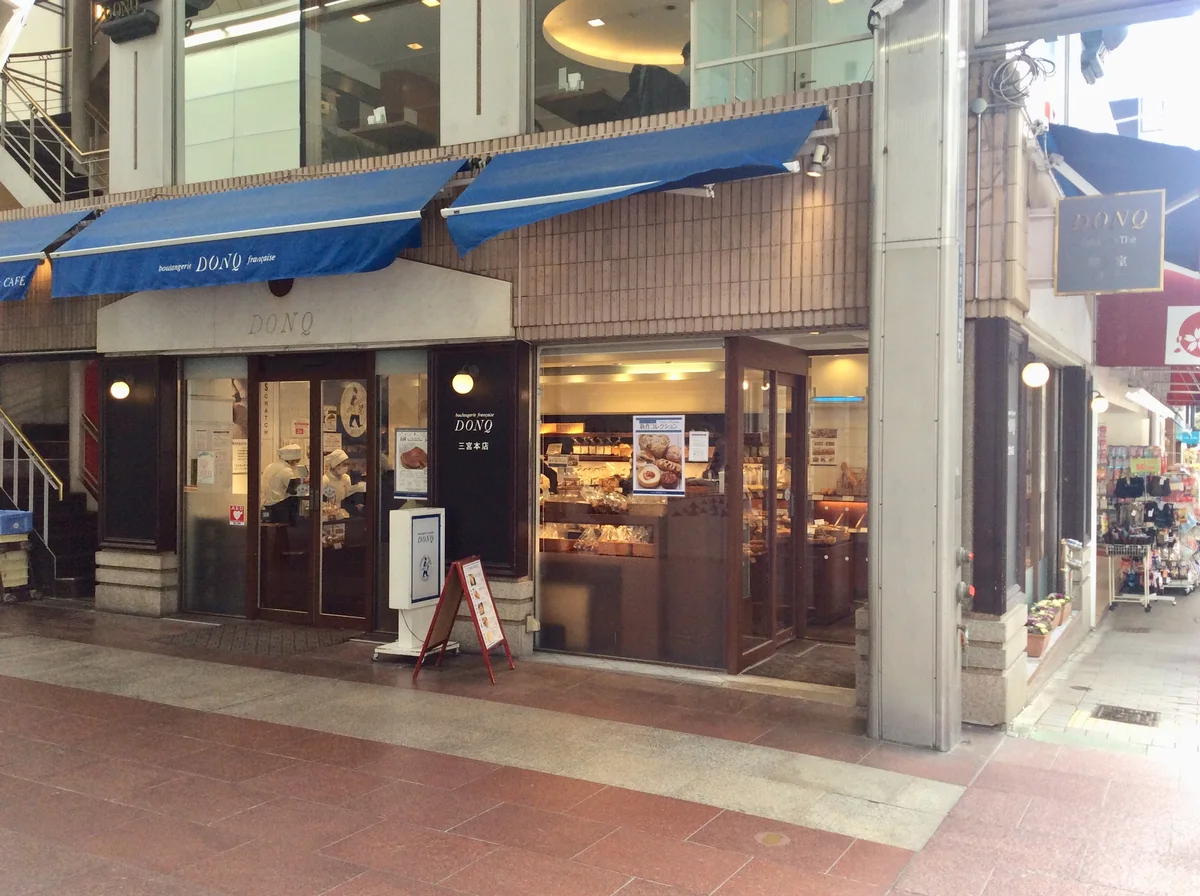
DONQ (ドンク) is the bakery that taught Japan what French bread is. It was founded on 8 August 1905 in Kobe by Motojiro Fujii as "Fujii Pan," in an era when most Japanese had never eaten bread at all. The playful name came later, in 1947: third-generation owner Yukio Fujii took "DONQ" from Don Quixote — a nod, via his brother-in-law, to his own headlong, dream-chasing character — and the flagship Sannomiya store in central Kobe, opened in 1951, remains the brand's home. DONQ's bakers trained with visiting French master Raymond Calvel in 1954 and with Philippe Bigot from 1965, and when the Aoyama shop opened in Tokyo in 1966, DONQ's crusty baguettes sparked Japan's first French-bread boom. The tricolour paper bag printed with a map of Paris, designed in the 1960s, became so fashionable that people carried it like an accessory — it is still the bag you will be handed today.
The defining discipline is the scratch method: at each bakery, bakers start from flour, mix and knead the dough, shape it and bake it in the store's own ovens — nothing is simply reheated from a central factory. That is why a department-store DONQ smells like a bakery, why baguettes come out in batches through the day, and why locals time their shopping to the baking schedule. The range runs from the classics — baguette, bâtard, croissant, brioche — to the dense, fine-crumbed pain de mie sandwich loaf, seasonal sweet breads, French pastries and savoury bakes. Alongside the main brand sit smaller formats: DONQ Édité, a compact edited selection, and Mini One, the beloved counter brand (born in 1984 at the Sapporo DONQ, spun off as its own brand in 2006) that sells bite-size croissants and mini pastries by weight, baked in small batches right at the counter.
You will meet DONQ where Japan does its serious food shopping: the basement food halls (depachika) of department stores, station buildings and large malls, from the Kobe Sannomiya flagship to Daimaru, Hankyu, Takashimaya, Isetan and JR station developments nationwide. It is less a tourist attraction than a slice of everyday Japanese food culture — which is exactly why it is worth a traveller's stop.
How to order
- Take a tray and tongs: At the entrance, pick up a tray (usually lined with a paper sheet) and a pair of tongs. This is the universal Japanese bakery system — never touch bread with your hands.
- Pick and load: Lift each bread with the tongs and set it on your tray. Baguettes and loaves sit in baskets or are handed over by staff; sliced bread and boxed pastries are pre-packed. If you want a loaf sliced, ask at the register — staff will cut it to your preferred thickness.
- Pay at the register: Staff bag everything, including the long tricolour paper sleeve for French bread. Payment follows the host store (cards, IC, QR and cash all normal).
- At Mini One, order by weight: Point at the mini croissants or other mini pastries and say a weight ("hyaku guramu" = 100 g) or a rough piece count. Staff weigh, bag and price them on the spot — there is no tray system at the counter.
- Cafe corners: DONQ locations with an attached cafe or eat-in space work separately: order and pay at the cafe counter for anything you eat in. Bread from the bakery side is normally for takeaway unless the store says otherwise.
What to order first
- Baguette (フランスパン): The founding product, made from the same scratch method for over half a century — crackling crust, open crumb. Buy it close to a baking batch if you can; bake times are posted or easy to ask about.
- Pain de Mie (パンドミ): DONQ's signature loaf — dense, moist, fine-textured, in domed "mountain" and square forms. Toast it thick for breakfast and you will understand its following.
- Mini Croissants at Mini One (ミニクロワッサン): Buttery, slightly sweet, endlessly snackable — ¥211 per 100 g (roughly 4–5 pieces) according to DONQ's official materials. Buy 100–200 g as a train snack.
- Croissant & Seasonal Sweet Breads: The classic croissant plus rotating seasonal items (chestnut in autumn, strawberry in spring) that reflect the Japanese bakery calendar.
- The Paris-Map Bag Moment: Whatever you buy, your French bread leaves in the tricolour Paris-map paper bag — a design icon since the 1960s and a souvenir in itself.
Payment & practical info
Prices and details checked: November 2026.
- Payment Accepted: As a tenant, DONQ follows the host building — major credit cards, transit IC (Suica, PASMO), QR/barcode payments and cash are all standard in department stores and station buildings. Department-store gift certificates and host-store point programmes may also apply.
- Hours: Follow the host building: department-store food halls typically run 10:00–20:00; station locations may open earlier and close later. Fresh batches sell out — the most popular items can be gone by late afternoon, and Mini One counters sometimes close when the day's mini croissants sell through.
- Tax-free — depends on the host store; DONQ has no chain-wide programme (checked 2026-11-11): DONQ itself does not advertise a tax-free service of its own. Where a DONQ sits inside a department store or complex that operates a tax-free counter, qualifying packaged purchases may be processed through the host store's tax-free procedure — ask at the host store's tax-free counter, not at the bakery register, and keep the day's receipts together. Two firm rules: (1) anything you eat in — cafe corners and eat-in spaces — is a service and never tax-free; (2) bread and pastries bought under a tax-free record are consumables: they must be taken out of Japan unconsumed — if you eat them in Japan, the whole tax-free record fails and no refund is paid for it. Food refunds are calculated at the 8% reduced tax rate, not 10%. If you simply want bread for today's picnic, buy it normally and enjoy it — the savings on a few hundred yen of bread are not worth freezing your snacks until departure.
Good to know / Common mistakes
- Tongs Are Not Optional: Using your hands — or carrying bread without a tray — marks you out instantly. Tray plus tongs, every time.
- Mini One Is a Separate Counter: Mini One shops often sit beside or inside DONQ, but they have their own register and weigh-by-gram system. Do not mix Mini One items onto a DONQ tray.
- "DONQ Édité" Is the Same Family: The smaller Édité shops carry a trimmed DONQ selection — same scratch baking, fewer lines. Johan and Marie-Catherine are also DONQ group brands, but they are different shops, not DONQ itself.
- Fresh Bread Does Not Travel Forever: Scratch-baked baguettes stale within a day. Buy souvenir loaves on your last day in Japan, not the first — and remember the consumables rule above if they went on a tax-free record.
- Ask for Your Slice Thickness: Japanese bakeries slice loaves by mai (slices per loaf) — 4 slices means thick toast-style, 8 means sandwich-thin. Point at the sample chart if words fail.
FAQ
- Q: Is DONQ tax-free?
- A: Not by itself. DONQ runs no chain-wide tax-free programme; tax-free processing, where it exists, is handled by the host department store's tax-free counter for qualifying purchases. Eat-in food is never tax-free, and bread bought on a tax-free record counts as a consumable — it must leave Japan uneaten, and the refund is at the 8% food rate.
- Q: What is the one thing to buy on a first visit?
- A: A baguette if you catch a fresh batch — and 100 g of Mini One mini croissants either way. Together they cover both halves of the DONQ story: its Kobe origins, later French-bread tradition and the by-weight mini counter introduced in 1984.
- Q: Can I eat inside?
- A: Some locations have cafe or eat-in corners; most department-store counters are takeaway only. Eat-in purchases are paid at the cafe counter and are never tax-free.
- Q: Where is the original store?
- A: The flagship stands in Sannomiya, Kobe — the company was founded in Kobe in 1905 and the Sannomiya main store has anchored the Center Gai shopping street since 1951. It is an easy pilgrimage stop if you are passing through Kobe.
- Q: Does DONQ bake on site, or is the bread shipped in?
- A: Baked on site. DONQ's identity is the scratch method — dough is made from flour and baked in each store's ovens, which is why bake times and sell-outs vary by location and hour.
Sources
- DONQ Official Website (Verified: 2026-11-11)
- DONQ Official Company Profile — founding date and store counts by brand (DONQ 113, DONQ Édité 32, Mini One 133, domestic, end of March 2026) (Verified: 2026-11-11)
- DONQ Official History — 1905 founding, the DONQ name, Calvel and Bigot, the Paris-map bag (Verified: 2026-11-11)
- Mini One Official Current Products — mini croissant ¥211 per 100 g (Checked: 2026-11-11)